
The Reliability Gap in Indian Solar Manufacturing
January 5, 2026
January 5, 2026


The Reliability Gap in Indian Solar Manufacturing
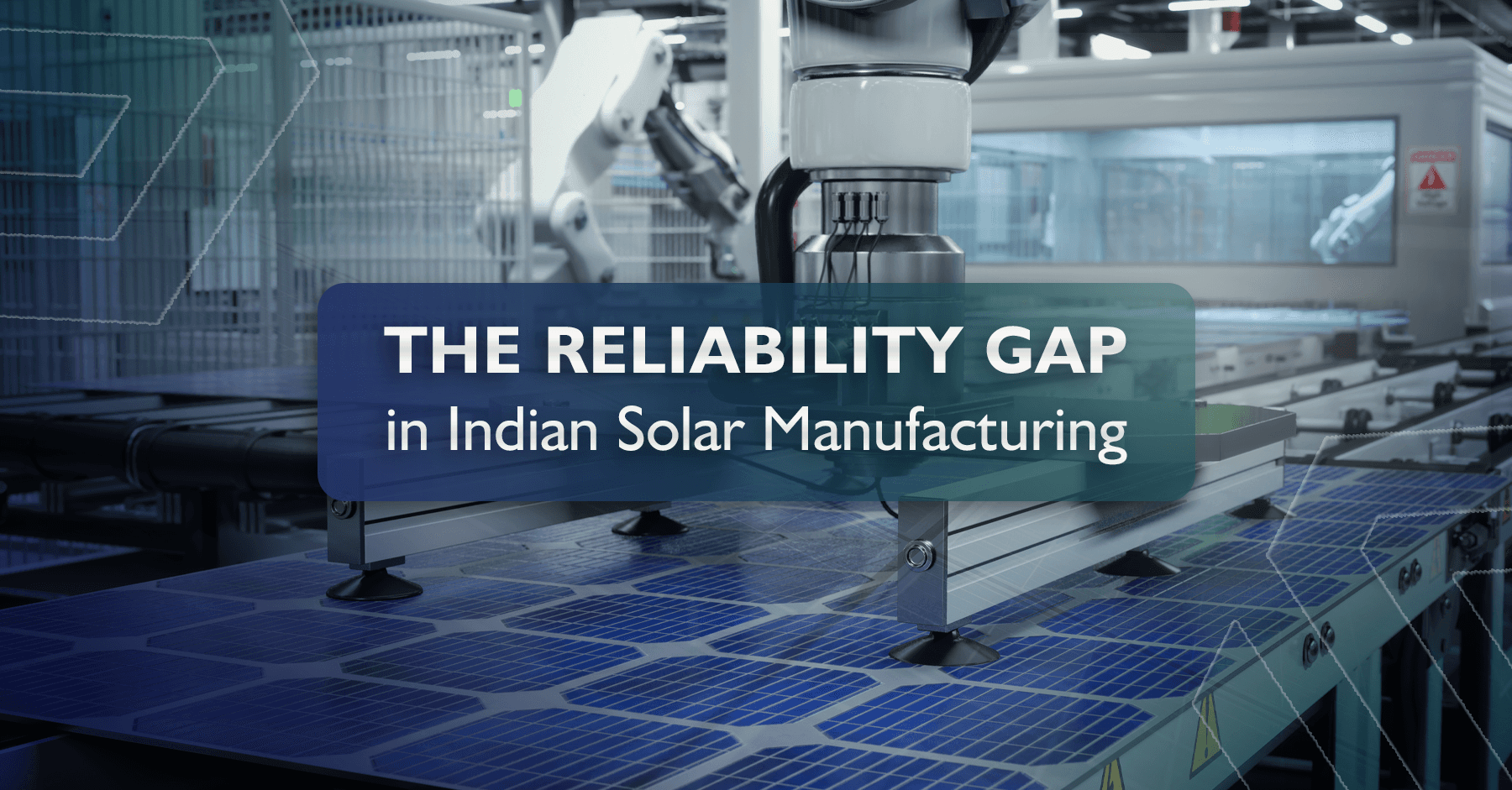
India’s solar story is impressive in scale.
But when you look closer, project by project, EPC by EPC, a quieter issue keeps resurfacing:
Reliability.
Despite aggressive capacity additions, incentives, and a strong domestic manufacturing push, the Indian solar sector continues to face a reliability gap that affects long-term performance, investor confidence, and lifecycle returns.
This isn’t about intent. It’s about execution.
India Builds Fast. But Does It Build to Last?
India’s solar momentum reached a historic milestone in 2025, with total installed capacity touching 132.85 GW by November, according to MNRE data. The industry is now scaling at an unprecedented pace, with ~41.5 GW of new solar installations projected for FY2026 alone.
Domestic module manufacturing has expanded just as rapidly, driven by:
PLI schemes, supporting 48+ GW of integrated module and cell capacity
ALMM mandates, with ~144.8 GW of domestic module capacity now enlisted
Import duties, including BCD on modules and anti-dumping duties on solar glass, are accelerating local supply chains
On paper, the ecosystem looks strong.
On the ground, however, EPCs and asset owners report a different reality:
High defect incidence, with industry audits indicating module defect rates exceeding 8% in some Indian facilities, among the highest globally
Cell-level vulnerabilities, accounting for ~22% of observed defects, especially during the rapid transition to high-efficiency TOPCon technologies
Premature failures, including microcracks, frame-related defects (~17.8% of reported findings), and lamination issues surfacing within the first few years of operation
This widening gap between rated performance and real-world durability is where reliability breaks down.
Where the Reliability Gap Actually Comes From
Reliability issues in Indian solar manufacturing rarely stem from a single flaw. They emerge from systemic shortcuts taken under cost and time pressure.
1. Inconsistent Quality Control
Many facilities still rely on sample-based testing instead of full-line automated inspection. This allows defects such as:
Microcracks and branching cracks
Foreign material contamination (~12.1% of defects)
Poor lamination and solder inconsistencies
to slip through, especially at high production speeds. These hidden flaws often evolve into hotspots, accelerated degradation, or even fire risks over time.
2. Cost-Optimized Bill of Materials (BOM)
To remain price-competitive, manufacturers may compromise on secondary materials.
While n-type technologies like TOPCon offer superior initial performance, pairing them with suboptimal backsheets, encapsulants, or glass thickness, particularly in India’s high-heat, high-humidity environments, can trigger:
Potential-Induced Degradation (PID)
Moisture ingress
Cumulative power losses ranging from 20% to 50% over the module lifetime if left unaddressed
3. Certification ≠ Reliability
Most modules meet mandatory IEC certifications. But certifications validate minimum compliance, not 25-year endurance.
While standard n-type modules target annual degradation rates of 0.35%–0.4%, budget-driven variants can experience rates as high as 0.8%, pushing effective capacity down to ~82.5% far earlier than projected.
A module can be certified—and still fail to perform reliably over its intended lifecycle.
4. Weak Traceability and After-Sales Support
As manufacturing scales, traceability often weakens. For EPCs and asset owners, this creates tangible risks:
No batch-level accountability for underperforming modules
Delayed or fragmented warranty responses
Ambiguity in addressing Light and Elevated Temperature-Induced Degradation (LeTID), which typically emerges 3–12 months post-installation
Reliability doesn’t end at dispatch. It extends across decades of operation.
Why This Gap Matters More Than Ever
India’s solar market is maturing. Buyers are no longer optimizing only for the lowest price per watt.
They are optimizing for:
Asset bankability
Predictable generation
Long-term ROI
Industry estimates suggest that even a marginal increase in annual degradation can erode ₹20,000–₹30,000 per kW over a project’s lifetime. With India’s renewable cost of capital remaining higher than in mature markets, every percentage point of energy yield directly impacts financial viability.
Reliability failures rarely show up on Day 1. They surface in Year 4, 7, or 10, when replacements are expensive, and reputations are already at stake.
Closing the Reliability Gap: What Must Change
Bridging this gap requires a shift from volume-first manufacturing to engineering-first manufacturing.
What reliable manufacturing actually looks like:
Fully automated production lines to reduce human variability
End-to-end quality control, including incoming material validation and 100% EL testing
Transparent performance documentation, reflecting degradation behavior under Indian thermal cycling
Designing for Indian climates, not just global certification benchmarks
Clear post-sales accountability, backed by data, traceability, and responsive technical support
Reliability isn’t a marketing claim.
It’s a manufacturing discipline.
The Future of Indian Solar Depends on Trust
India doesn’t just need more solar capacity. It needs solar assets that endure.
As project sizes grow, financial diligence tightens, and EPC margins compress, reliability, not price, will define the next competitive frontier.
The manufacturers who lead the next decade will understand a simple truth:
Clean energy must be predictable.
Long-term performance is not optional.
Trust is engineered
Closing the reliability gap isn’t just good engineering. It’s essential for India’s energy future.

The Reliability Gap in Indian Solar Manufacturing
India’s solar story is impressive in scale.
But when you look closer, project by project, EPC by EPC, a quieter issue keeps resurfacing:
Reliability.
Despite aggressive capacity additions, incentives, and a strong domestic manufacturing push, the Indian solar sector continues to face a reliability gap that affects long-term performance, investor confidence, and lifecycle returns.
This isn’t about intent. It’s about execution.
India Builds Fast. But Does It Build to Last?
India’s solar momentum reached a historic milestone in 2025, with total installed capacity touching 132.85 GW by November, according to MNRE data. The industry is now scaling at an unprecedented pace, with ~41.5 GW of new solar installations projected for FY2026 alone.
Domestic module manufacturing has expanded just as rapidly, driven by:
PLI schemes, supporting 48+ GW of integrated module and cell capacity
ALMM mandates, with ~144.8 GW of domestic module capacity now enlisted
Import duties, including BCD on modules and anti-dumping duties on solar glass, are accelerating local supply chains
On paper, the ecosystem looks strong.
On the ground, however, EPCs and asset owners report a different reality:
High defect incidence, with industry audits indicating module defect rates exceeding 8% in some Indian facilities, among the highest globally
Cell-level vulnerabilities, accounting for ~22% of observed defects, especially during the rapid transition to high-efficiency TOPCon technologies
Premature failures, including microcracks, frame-related defects (~17.8% of reported findings), and lamination issues surfacing within the first few years of operation
This widening gap between rated performance and real-world durability is where reliability breaks down.
Where the Reliability Gap Actually Comes From
Reliability issues in Indian solar manufacturing rarely stem from a single flaw. They emerge from systemic shortcuts taken under cost and time pressure.
1. Inconsistent Quality Control
Many facilities still rely on sample-based testing instead of full-line automated inspection. This allows defects such as:
Microcracks and branching cracks
Foreign material contamination (~12.1% of defects)
Poor lamination and solder inconsistencies
to slip through, especially at high production speeds. These hidden flaws often evolve into hotspots, accelerated degradation, or even fire risks over time.
2. Cost-Optimized Bill of Materials (BOM)
To remain price-competitive, manufacturers may compromise on secondary materials.
While n-type technologies like TOPCon offer superior initial performance, pairing them with suboptimal backsheets, encapsulants, or glass thickness, particularly in India’s high-heat, high-humidity environments, can trigger:
Potential-Induced Degradation (PID)
Moisture ingress
Cumulative power losses ranging from 20% to 50% over the module lifetime if left unaddressed
3. Certification ≠ Reliability
Most modules meet mandatory IEC certifications. But certifications validate minimum compliance, not 25-year endurance.
While standard n-type modules target annual degradation rates of 0.35%–0.4%, budget-driven variants can experience rates as high as 0.8%, pushing effective capacity down to ~82.5% far earlier than projected.
A module can be certified—and still fail to perform reliably over its intended lifecycle.
4. Weak Traceability and After-Sales Support
As manufacturing scales, traceability often weakens. For EPCs and asset owners, this creates tangible risks:
No batch-level accountability for underperforming modules
Delayed or fragmented warranty responses
Ambiguity in addressing Light and Elevated Temperature-Induced Degradation (LeTID), which typically emerges 3–12 months post-installation
Reliability doesn’t end at dispatch. It extends across decades of operation.
Why This Gap Matters More Than Ever
India’s solar market is maturing. Buyers are no longer optimizing only for the lowest price per watt.
They are optimizing for:
Asset bankability
Predictable generation
Long-term ROI
Industry estimates suggest that even a marginal increase in annual degradation can erode ₹20,000–₹30,000 per kW over a project’s lifetime. With India’s renewable cost of capital remaining higher than in mature markets, every percentage point of energy yield directly impacts financial viability.
Reliability failures rarely show up on Day 1. They surface in Year 4, 7, or 10, when replacements are expensive, and reputations are already at stake.
Closing the Reliability Gap: What Must Change
Bridging this gap requires a shift from volume-first manufacturing to engineering-first manufacturing.
What reliable manufacturing actually looks like:
Fully automated production lines to reduce human variability
End-to-end quality control, including incoming material validation and 100% EL testing
Transparent performance documentation, reflecting degradation behavior under Indian thermal cycling
Designing for Indian climates, not just global certification benchmarks
Clear post-sales accountability, backed by data, traceability, and responsive technical support
Reliability isn’t a marketing claim.
It’s a manufacturing discipline.
The Future of Indian Solar Depends on Trust
India doesn’t just need more solar capacity. It needs solar assets that endure.
As project sizes grow, financial diligence tightens, and EPC margins compress, reliability, not price, will define the next competitive frontier.
The manufacturers who lead the next decade will understand a simple truth:
Clean energy must be predictable.
Long-term performance is not optional.
Trust is engineered
Closing the reliability gap isn’t just good engineering. It’s essential for India’s energy future.

Join the renewable energy movement with SLR
Discover sustainable solutions that reduce costs and environmental impact. Take the first step today!

Join the renewable energy movement with SLR
Discover sustainable solutions that reduce costs and environmental impact. Take the first step today!

Join the renewable energy movement with SLR
Discover sustainable solutions that reduce costs and environmental impact. Take the first step today!


